
BSA Small Grants Fund: Reports on Performances
28th April 2026
The BSA’s Small Grants Fund supports a wide variety of projects. Two recipients of BSA’s SGF share reports about performance-based events that were partially funded by the scheme below.
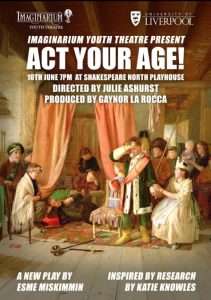
‘Act Your Age’ – Research in Action in a Collaborative Youth Theatre Project
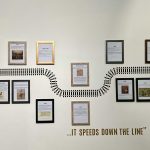
Last spring, Esme Miskimmin and Katie Knowles (University of Liverpool) worked on a collaborative project with a youth theatre group, Imaginarium, from Prescot, Merseyside and the Shakespeare North Playhouse. The project involved a play, Act Your Age, written by Esme and based on Katie’s original research into all-child acting companies in the Early Modern and Victorian periods, and an exhibition telling the fascinating story of child performers throughout UK theatre history. The project was intended to be entertaining and family friendly – both the play and the exhibition offered opportunities for fun and imagination, but there was also the chance for audiences to rethink the connections between past and present, and to learn about the way that perceptions of work and play change through time, especially in relation to children’s roles in the theatre.
The young actors from Imaginarium were truly wonderful, taking to the Cockpit stage with confidence and enthusiasm and visiting the past through the dramatic device of a time-travelling train and some nifty costume changes (funded in part by a BSA Small Grant Fund). They brought life and clarity to the project in ways Esme and Katie weren’t expecting and showed that approaching academic work though collaboration with the wider community can be hugely beneficial to everyone.
Shakespeare’s Emotional Sound – Performance Research
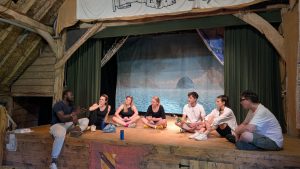
For three days in May 2025, seven actors, actor-musicians, assistant director Karina Aviva and director Victoria Gartner gathered in Kent at the Barn at Smallhythe Place, Dame Ellen Terry’s home managed by the National Trust, in order to explore ‘Shakespeare’s emotional sound.’
The aim of the research was to explore how words can be removed from Shakespeare while the rhythm and sounds themselves give us clues as to the emotional and physical life of the actors, and to the story developing on stage. The question at the centre of the research is: is there something transmitted purely through sound, through the rhythm of the pentameter and the melody of Shakespeare’s chosen words, that creates emotional meaning for an audience and / or actors?
Actors were given ‘sheet music’ in the form of the iambic, and asked to beat it in time with their character’s turn to speak, not knowing which scene they were playing out. Other experiments involved inviting actors to respond only to sounds, or rhythms, or both. The results were fascinating, with actors sometimes offering incredibly appropriate blocking (Ophelia and Hamlet’s ‘I have remembrances of yours’ for instance) or instinctively accurate guesses as to what was happening in the scene (‘I think there’s a snake’ for Cleopatra’s death, or ‘I think I die’ for Julius Caesar) with only the help of repeated sounds or the beating of a rhythm. The actor-musicians also involved several musical instruments – a drum, pans, a flute, a melodion in their exploration of sounds, as well as singing and movement.
This research built on activities of a first workshop of the same genre and style, and strongly suggests there is a correlation between musicality – rhythm and sound – and our perception of emotions within Shakespeare’s text. This exploration could lead to a new way of exploring Shakespeare, especially for people who might not have access to the language for a myriad of different reasons, and Victoria Gartner will explore it further in an essay representing the research and also in a documentary project.
Applications for the SGF
BSA members in good standing are eligible to apply for up to £500 to support a wide range of activities. The deadline for the next round of applications is 30th September. More details are available here: https://www.britishshakespeare.ws/bsa-small-grants-fund/