
Promoting the study, practice
and enjoyment of Shakespeare.

Join today

Latest News and Info

BSA Small Grants Fund: Reports on Performances

The BSA’s Small Grants Fund supports a wide variety of projects. Two recipients of BSA’s SGF share reports about performance-based events that were partially funded by the scheme below.

‘Act Your Age’ – Research in Action in a Collaborative Youth Theatre Project

Last spring, Esme Miskimmin and Katie Knowles (University of Liverpool) worked on a collaborative project with a youth theatre group, Imaginarium, from Prescot, Merseyside and the Shakespeare North Playhouse. The project involved a play, Act Your Age, written by Esme and based on Katie’s original research into all-child acting companies in the Early Modern and Victorian periods, and an exhibition telling the fascinating story of child performers throughout UK theatre history. The project was intended to be entertaining and family friendly – both the play and the exhibition offered opportunities for fun and imagination, but there was also the chance for audiences to rethink the connections between past and present, and to learn about the way that perceptions of work and play change through time, especially in relation to children’s roles in the theatre.

The young actors from Imaginarium were truly wonderful, taking to the Cockpit stage with confidence and enthusiasm and visiting the past through the dramatic device of a time-travelling train and some nifty costume changes (funded in part by a BSA Small Grant Fund). They brought life and clarity to the project in ways Esme and Katie weren’t expecting and showed that approaching academic work though collaboration with the wider community can be hugely beneficial to everyone.

Shakespeare’s Emotional Sound – Performance Research

For three days in May 2025, seven actors, actor-musicians, assistant director Karina Aviva and director Victoria Gartner gathered in Kent at the Barn at Smallhythe Place, Dame Ellen Terry’s home managed by the National Trust, in order to explore ‘Shakespeare’s emotional sound.’

The aim of the research was to explore how words can be removed from Shakespeare while the rhythm and sounds themselves give us clues as to the emotional and physical life of the actors, and to the story developing on stage. The question at the centre of the research is: is there something transmitted purely through sound, through the rhythm of the pentameter and the melody of Shakespeare’s chosen words, that creates emotional meaning for an audience and / or actors?

Actors were given ‘sheet music’ in the form of the iambic, and asked to beat it in time with their character’s turn to speak, not knowing which scene they were playing out. Other experiments involved inviting actors to respond only to sounds, or rhythms, or both. The results were fascinating, with actors sometimes offering incredibly appropriate blocking (Ophelia and Hamlet’s ‘I have remembrances of yours’ for instance) or instinctively accurate guesses as to what was happening in the scene (‘I think there’s a snake’ for Cleopatra’s death, or ‘I think I die’ for Julius Caesar) with only the help of repeated sounds or the beating of a rhythm. The actor-musicians also involved several musical instruments – a drum, pans, a flute, a melodion in their exploration of sounds, as well as singing and movement.

This research built on activities of a first workshop of the same genre and style, and strongly suggests there is a correlation between musicality – rhythm and sound – and our perception of emotions within Shakespeare’s text. This exploration could lead to a new way of exploring Shakespeare, especially for people who might not have access to the language for a myriad of different reasons, and Victoria Gartner will explore it further in an essay representing the research and also in a documentary project.

Applications for the SGF

BSA members in good standing are eligible to apply for up to £500 to support a wide range of activities. The deadline for the next round of applications is 30th September. More details are available here: https://www.britishshakespeare.ws/bsa-small-grants-fund/

BSA Small Grants Fund: Events Reports

The BSA’s Small Grants Fund supports a wide variety of projects. Two recipients of BSA’s SGF share reports about events that were partially funded by the scheme below.

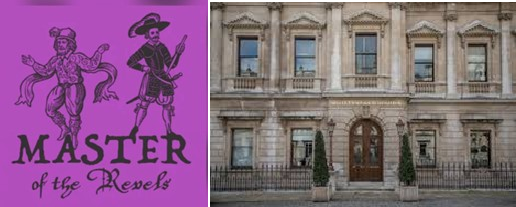
Revels Office: New Voices in Early Modern Material Culture, Theatre, and Performance

On Friday 13th June, the Revels Office Research Network, in collaboration with the Society of Antiquaries, held the ‘Revels Office: New Voices in Early Modern Material Culture, Theatre, and Performance’ conference at Burlington House. This hybrid event celebrated the work of early career scholars working on early modern material culture, theatre, and performance in Great Britain and Ireland (1500-1800).

The day encompassed rich reflections on matter and its meaning both inside and outside the playhouse. Papers investigated topics including cosmetics and race-making, costume, the senses, and performances of gender, power, and identity. The panel “Bibliographic Interests: Texts of and in Performance,” which was generously supported by the Bibliographical Society, was a particular highlight, with papers exploring the diary of Philip Henslowe, the early modern cue system, and the career of the printer John Danter. Professor Catherine Richardson FSA gave a fascinating keynote on her new book ‘Shakespeare’s Objects: Engaging the Off-Stage Lives of Early Modern Props’, in which she argued that a sustained engagement with the materiality of objects, the nature of props, and stage practice has a profound impact on the way in which we understand issues of identity and lived experience in the early modern period.

We hosted 45 in-person attendees, with 70 delegates participating online. Feedback from the day was enthusiastic, with attendees praising the ‘fabulous range of speakers’ who covered ‘a great spread of topics’. As an online network founded during the pandemic, this day was a special opportunity for the international Revels Office community to come together to share and celebrate research past, present, and future. The Revels Office would like to thank the British Shakespeare Association for their generous support of the conference.

By Bethan Davies
Shakespeare and the Politics of Subtitling

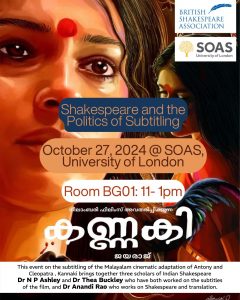
On 27 October 2024 ‘Shakespeare and the Politics of Subtitling’, a BSA Small Grants-funded event, took place at SOAS. The event brought together three Indian Shakespeares scholars: Dr Anandi Rao (SOAS) who works on Shakespeare and translation, and Drs N. P. Ashley (St Stephen’s College, U of Delhi) and Thea Buckley (QUB), who have both worked on the English subtitles of Kannaki, the film under discussion. An adaptation of William Shakespeare’s play Antony and Cleopatra, Kannaki is a 2002 Indian National Award-winning Malayalam-language tragedy written by Sanjeev Kilikulam and directed by Jayaraj R. Nair, who also participated online at this event as Guest Speaker.

‘Shakespeare and the Politics of Subtitling’ was attended by students, alumni, academics from UK and international universities, translators, and practitioners. The event was convened by Dr Anandi Rao, Lecturer in South Asian Studies at SOAS, University of London. Two academics had worked on the subtitles — NP Ashley, who recently translated The Comedy of Errors into Malayalam as part of his Kerala Shakespeares project, discussed drafting the first iteration of subtitles in an era before AI or auto translations and e-dictionaries. Dr Thea Buckley, who works on Indian Shakespeare in film, performance and translation, and is currently co-editing a special Shakespeare journal issue on Indian cinema, worked on the second draft of the subtitles and embedded these into selected clips from the film Kannaki.

The first part of the session involved a live audience Q&A with director Jayaraj, who appeared online from Kerala and explained the symbolism, narrated filming anecdotes and answered audience questions. Questions ranged from ‘Why Shakespeare?’ to how the lyrics, tunes, language(s) and linguistic setting of the film were chosen. The borders of India’s Southern states were decided after independence along linguistic boundaries. Thus, politics is automatically embedded in acts of choice of script, accent, metaphor, and dialogue in the case of this movie, set on the Kerala-Tamil Nadu border.  

Next, N. P. Ashley and Thea Buckley discussed selected scenes from the film and the related challenges involved in subtitling these, from fitting lines onto a single row of onscreen text, and how to handle slang and words with double meanings, to whether to translate for literal sense or to privilege rhythm, metaphor or rhyme? Who is the subtitle for? Which audience? What acts of subalternity inhere? Who is included or excluded? Where does Shakespeare fit in and how is his work translated and re-translated in the act of scripting and Subtitling? Were some of the questions addressed. 

The event concluded with screening more songs and scenes from the film, followed by discussing further reading and further directions of scholarship.

By Thea Buckley
Application for the SGF

BSA members in good standing are eligible to apply for up to £500 to support a wide range of activities. The next round of applications will close on 30th March. More details are available here: https://www.britishshakespeare.ws/bsa-small-grants-fund/

BSA Small Grants Fund

Purpose:

The purpose of the BSA’s Small Grants Fund is to offer financial support to members of the BSA who wish to organize a Shakespeare-related event or conduct Shakespeare-related research. We especially encourage proposals from doctoral and early career researchers, teachers and educators, and creative practitioners. 

Examples of eligible costs include:

  • Expenses associated with staging performances (e.g. costumes, props, accessibility aids)
  • Expenses associated with accessibility (e.g. sign-language interpreting for events or performances; fees paid for captioning videos)
  • Fees for online streaming / video platforms (e.g. Crowdcast, Zoom Premium, Vimeo)
  • Fees for video editing software (for filmed performances)
  • Funding to conduct research, such as travel to a library or archive
  • Digitization costs
  • Reproduction fees for images 
  • Funding for conference attendance as a presenter
  • Travel expenses for unsalaried speakers / practitioners.

We welcome applications for awards of up to £500.

Eligibility:

You must be a member in good standing of the BSA (i.e. have paid your membership dues for the relevant period).

How to apply:

The next round of applications closes on 30 March 2026. Application instruction are available via the ‘Small Grants Fund’ icon on your BSA member’s dashboard after login.

Website by Agency For Good

Copyright 2026. All Rights Reserved